 EN
EN

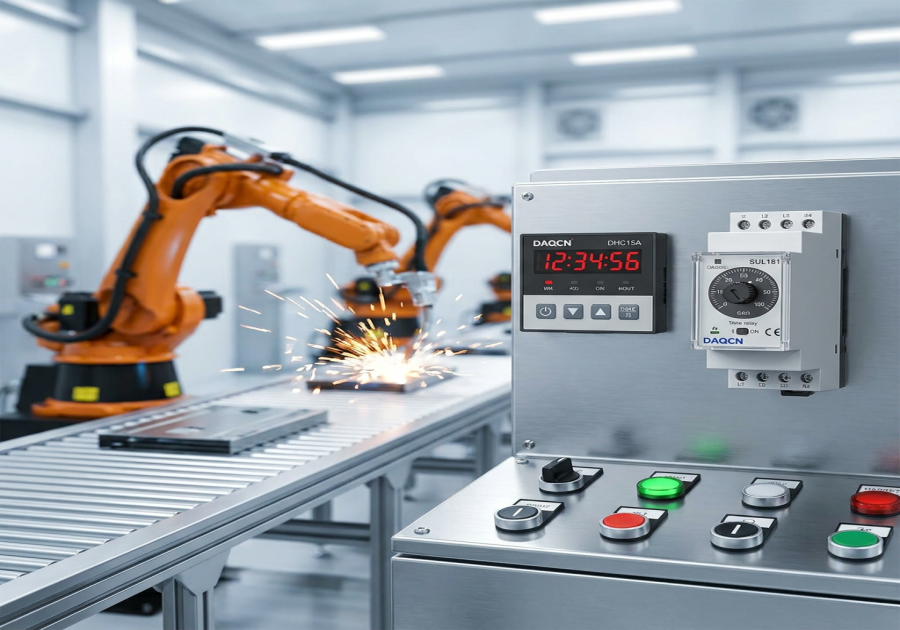
Introduction: The Pulse of Modern Manufacturing
In the high-stakes world of industrial manufacturing, time is more than just a measurement—it is a critical parameter of quality and efficiency. From the precise curing of chemical compounds to the sequential operation of heavy-duty hydraulic presses, the ability to control 'when' and 'how long' determines the success of a production run.
While high-end PLCs (Programmable Logic Controllers) handle complex logic, the humble time relay remains the backbone of localized automation. Modern time relays have evolved far beyond simple delay-on timers; they are now sophisticated control devices capable of managing intricate workflows with microsecond precision. This article explores how DAQCN’s leading time control solutions, specifically the digital DHC15A and the analog SUL181, are driving the next generation of manufacturing precision.
The Strategic Importance of Timing in Automation
Automated workflows rely on the synchronization of multiple components. A failure in timing by even a few seconds can lead to wasted raw materials, machine damage, or safety hazards. Time relays provide several essential functions in these environments:
1. Sequential Control: Ensuring that Component A starts only after Component B has been operational for a specific duration (e.g., a cooling fan starting after a furnace begins heating).
2. Energy Management: Automatically shutting down non-essential systems (lighting, HVAC, conveyors) during off-peak hours or shifts.
3. Process Consistency: Maintaining uniform dwell times in processes like heat sealing, electroplating, or industrial mixing.
For systems integrators, selecting the right timing technology—whether digital for complexity or analog for simplicity—is the first step in building a resilient automation architecture.
Spotlight on Digital Precision: The DHC15A Programmable Timer
The DAQCN DHC15A stands as a testament to the power of digital timing logic. Designed for DIN-rail mounting, this weekly programmable time switch is the preferred choice for complex manufacturing workflows that require high flexibility.
1. Multi-Program Logic and Flexibility
The DHC15A offers up to 32 ON/OFF programs, allowing for highly granular control throughout a 7-day cycle. For a factory owner, this means a single device can manage different operating schedules for weekdays and weekends, or accommodate complex multi-shift rotations without manual intervention. The LCD display provides a clear, real-time interface for monitoring and adjustments, ensuring that operators always have visibility into the current automation state.
2. Industrial-Grade Reliability and Power Reserve
Manufacturing environments are often prone to power interruptions. The DHC15A addresses this with a built-in rechargeable battery that provides a 150-hour power reserve. This ensures that even during a total facility power loss, the internal clock and programmed logic remain intact. Once power is restored, the system resumes its schedule perfectly, eliminating the need for costly and time-consuming reprogramming.
3. Anti-Jamming and High-Precision Hardware
Equipped with industrial-grade chips and advanced anti-interference circuitry, the DHC15A maintains its precision even in high-EMI (electromagnetic interference) environments where large motors or welding equipment are operational. This 'electronic ruggedness' is what separates DAQCN’s professional-grade timers from generic alternatives.
The Analogue Classic: SUL181 and the Power of Simplicity
While digital timers offer complexity, the SUL181 mechanical/analogue time relay remains an industry staple for its intuitive design and unwavering reliability. In many manufacturing scenarios, the visual feedback of an analog interface is irreplaceable.
1. Quartz-Controlled Stability
The SUL181 utilizes quartz-controlled timing to ensure long-term accuracy. Its daily programming interface, featuring 96 switching segments, allows for 15-minute interval control. This is ideal for processes like municipal street lighting, industrial ventilation, or periodic lubrication cycles where the schedule remains consistent day-to-day.
2. Immediate Visual Configuration
For maintenance technicians on the factory floor, the SUL181 offers the advantage of 'at-a-glance' verification. By looking at the position of the mechanical pins, an operator can immediately confirm the programmed schedule without navigating digital menus. This simplicity reduces the chance of human error during setup and troubleshooting.
Integrating Time Relays into the Smart Factory Ecosystem
Modern manufacturing is moving toward a more integrated, 'Smart Factory' model. DAQCN’s time relays are designed to be team players within this ecosystem. They can be easily integrated with other control components:
- Collaboration with General Purpose Relays: Timers can act as the 'brain' that triggers larger DAQCN MY2 or LY2 power relays to handle high-current loads.
- Integration with Energy Meters: By combining timing logic with energy monitoring, facilities can identify energy-intensive processes and schedule them for periods when electricity rates are lower, significantly reducing operational costs.
- Hybrid Automation: Using digital timers (DHC15A) for primary process control and analog timers (SUL181) for secondary support systems provides a balanced and cost-effective automation strategy.
The DAQCN Quality Commitment
At Wenzhou DAQUAN Electric (DAQCN), we understand that in a manufacturing workflow, every second counts. Since 1996, we have focused on producing electrical components that exceed international standards. Our ISO9001-certified factory utilizes advanced foreign technologies and rigorous testing protocols to ensure that every DHC15A and SUL181 relay leaving our facility is ready for the rigors of global industry.
Our OEM and ODM services allow us to partner with systems integrators to develop custom timing solutions tailored to specific industrial challenges. Whether it's adjusting voltage limits, extending battery life, or modifying contact configurations, our R&D team is dedicated to 'Higher, Finer, More Comprehensive' engineering.
Conclusion: Precision as a Competitive Advantage
As manufacturing becomes more globalized and competitive, the margin for error shrinks. Precision is no longer a luxury; it is a competitive necessity. By leveraging the advanced timing logic of modern relays, factory owners can achieve higher levels of automation, lower energy costs, and superior process consistency.
Choosing DAQCN as your partner in automation means choosing a legacy of reliability and a future of innovation. Whether through the digital sophistication of the DHC15A or the time-tested reliability of the SUL181, we provide the precision that keeps your factory moving forward.
---
Explore the full range of DAQCN time switches and industrial control devices at [cndaqcn.com](https://www.cndaqcn.com). Contact us today for a quote or a technical consultation.
Table of Contents
- Introduction: The Pulse of Modern Manufacturing
- The Strategic Importance of Timing in Automation
- Spotlight on Digital Precision: The DHC15A Programmable Timer
- The Analogue Classic: SUL181 and the Power of Simplicity
- Integrating Time Relays into the Smart Factory Ecosystem
- The DAQCN Quality Commitment
- Conclusion: Precision as a Competitive Advantage