 EN
EN

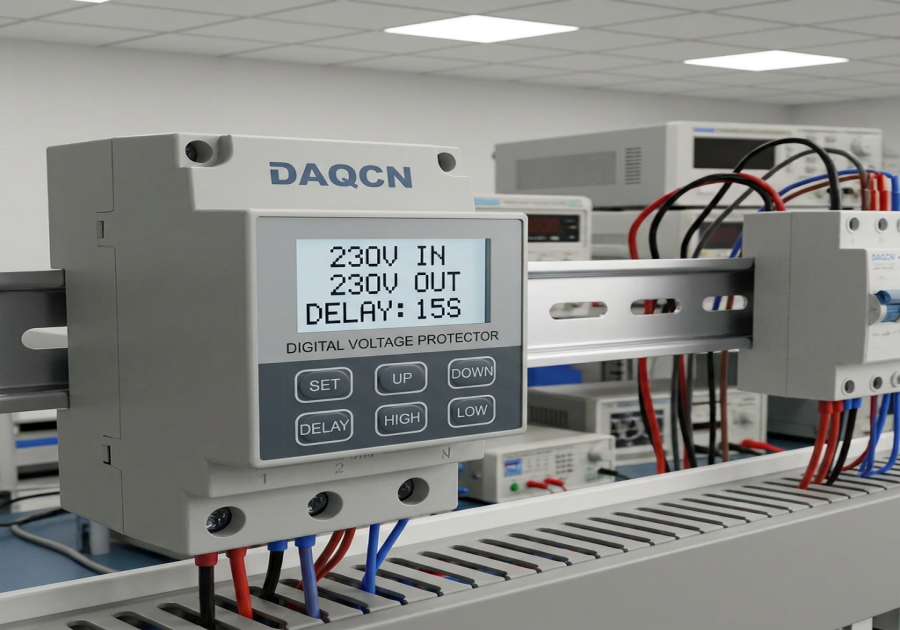
In the high-stakes world of industrial procurement, selecting a voltage protector often feels like a routine checkbox exercise. Buyers look for the basic voltage range, the price point, and perhaps the delivery timeline. However, for industrial equipment—where a single power surge or brownout can lead to hundreds of thousands of dollars in lost production—the 'standard' specs are rarely enough.
At DAQCN Electric, we have spent decades analyzing field failures and equipment damage in industrial settings. Our findings show that it is the technical nuances—the specs often buried deep in the datasheet—that determine the longevity of your machines. Here are the top five technical specifications B2B buyers often overlook when selecting voltage protectors.
#### 1. Adjustable Reconnection Delay (Self-Recovery Time)
Most buyers check the 'Protection Time' (the speed at which the device trips), but many forget to look at the 'Reconnection Delay.' In many low-end protectors, this is a fixed value. For B2B buyers managing refrigeration, HVAC, or high-pressure compressors, a fixed or too-short delay can be fatal to the equipment.
When power is restored after a dip or surge, the pressure in a compressor system needs time to equalize before restarting. If the voltage protector restores power instantly, the motor may try to start against high back-pressure, leading to burnout. DAQCN’s premium voltage protectors feature adjustable delay settings (from 1 second to 500 seconds), allowing procurement officers to tailor the protection to the specific inertia and pressure requirements of their machinery.
#### 2. Dynamic Leakage Protection Sensitivity
A voltage protector should protect against more than just high or low voltage. In industrial environments, moisture, dust, and aging insulation often cause 'silent' current leaks. While a standard circuit breaker might trip at 30mA, it does so only to protect human life.
For industrial IoT solution providers, the overlooking of leakage protection granularity is a mistake. High-quality protectors now integrate leakage monitoring that can detect micro-leaks before they become short circuits. This 'early warning' capability is essential for equipment that operates in humid or harsh environments, such as food processing or outdoor telecommunications cabinets. Choosing a device with adjustable leakage thresholds (e.g., 10mA to 99mA) ensures that you can find the balance between safety and avoiding nuisance tripping.
#### 3. Response Time vs. Suppression Threshold
Many datasheets highlight a 'Response Time' of <0.1s. However, B2B buyers must ask: What happens during that 0.1s? In the world of sensitive electronics—PLCs, CNC machines, and server racks—a surge can do its damage in microseconds.
Advanced voltage protectors utilize a combination of mechanical relays and electronic sensing. The 'Overlook' here is often the Reset Accuracy. A protector might trip at 270V, but if its tolerance is +/- 5%, it might actually let 283V through before acting. DAQCN utilizes high-precision microprocessors to ensure that the trip point is stable within a 1% margin, providing a much tighter safety envelope for expensive industrial controllers.
#### 4. Housing Material: The VO Rating and Thermal Stability
In industrial procurement, the 'external' is just as important as the 'internal.' A voltage protector is often the last line of defense in an electrical fire. Cheap units use ABS plastic that can support a flame and emit toxic smoke.
Professional B2B buyers should look for UL94-V0 rated flame-retardant materials. A 'V0' rating means that the plastic will stop burning within 10 seconds of a flame being removed and will not drip flaming particles. Additionally, thermal stability is crucial. Industrial cabinets can reach high temperatures; a protector that derates or becomes inaccurate at 50°C is a liability. DAQCN products are tested for a wide operating temperature range (-25°C to +65°C) to ensure consistent performance in the most demanding environments.
#### 5. Intelligent Communication and Remote Diagnostics
As factories scale their IoT capabilities, the 'isolated' voltage protector is becoming a relic. A spec that is frequently overlooked is the Communication Interface. Does the device support WiFi, RS485 (Modbus), or Tuya integration?
For a procurement officer managing multiple remote sites (such as solar farms or base stations), being able to remotely see why a protector tripped—was it over-voltage, leakage, or a phase loss?—saves a truck roll and hours of troubleshooting. DAQCN’s WiFi-enabled voltage protectors allow for real-time data streaming to the Tuya platform, turning a simple safety device into a valuable source of power quality data.
#### The DAQCN Advantage: Engineering for the Overlooked
Since 1996, DAQCN (Wenzhou DAQUAN Electric Co., Ltd) has focused on the details that others ignore. Our R&D team continuously upgrades our voltage protectors to include adjustable delay, high-precision leakage sensing, and smart connectivity.
By partnering with DAQCN for your OEM or ODM needs, you gain access to:
- Certified Quality: ISO9001 factory standards with CE, ROHS, and TUV certifications.
- Industrial Durability: 258 patents reflecting our innovation in protection technology.
- Logistical Efficiency: Fast turnaround times from our 7,800 sqm facility in Wenzhou.
#### Conclusion
Procurement is not just about buying a product; it is about mitigating risk. By looking beyond the primary label and focusing on adjustable delay, leakage sensitivity, material quality, and smart integration, B2B buyers can ensure their electrical infrastructure is truly protected. When the cost of failure is high, the technical specs you 'overlooked' become the most expensive mistakes you will ever make. Choose a partner like DAQCN who understands the technical demands of the modern industrial world.