

Introduction: Why Heat is the Enemy of Solid State Relays
High-power Solid State Relays (SSRs) are widely preferred in industrial automation for controlling high-current heating elements, motors, and industrial lighting loads. Because SSRs contain no moving mechanical contacts, they are free from mechanical wear. However, their reliance on semiconductor power devices (such as Thyristors, Triacs, or MOSFETs) introduces a major physical constraint: internal heat generation.
During operation, a small internal forward voltage drop (typically 1.0 to 1.6 Volts) occurs across the semiconductor junction of the SSR. This voltage drop, multiplied by the load current passing through the device, generates heat. For example, an SSR switching a 40 Amp load can generate 40 to 60 Watts of heat inside its housing. Without an adequate heatsink to dissipate this thermal energy, the internal semiconductor junction temperature will quickly exceed its maximum limit (usually 125 degrees Celsius). This leads to immediate thermal runaway, rendering the SSR permanently damaged in a short-circuit state. For B2B engineers and control panel builders, choosing the correct heatsink size is critical to ensuring the longevity and safety of the system. This guide walks you through the step-by-step thermal calculation process.
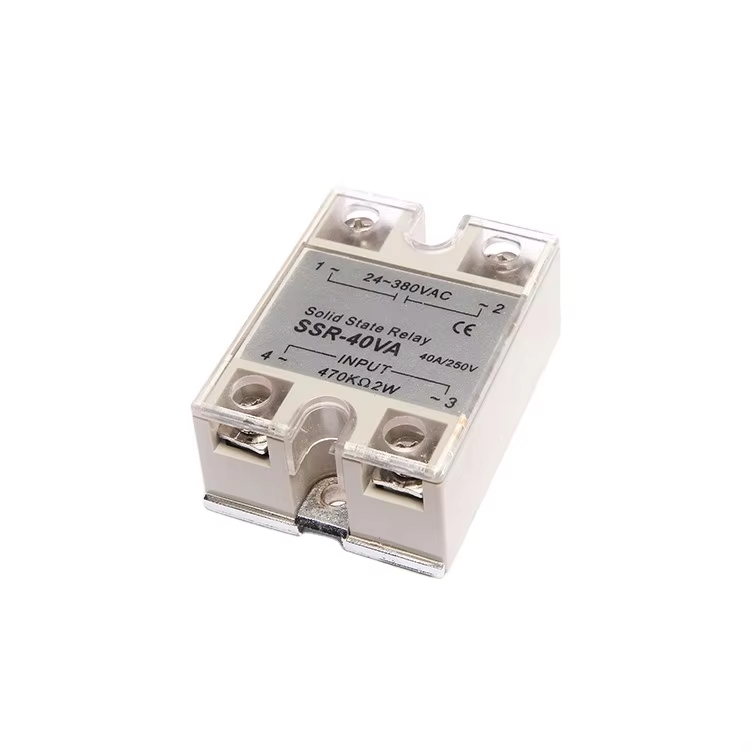
The Physics of Thermal Resistance in SSR Assemblies
To select the right heatsink, we must understand the concept of thermal resistance, which is represented by the symbol Rth and measured in degrees Celsius per Watt (C/W). Thermal resistance is the opposition of a substance or assembly to the flow of heat. A lower Rth rating means that heat can flow more easily, resulting in better cooling.
In an SSR and heatsink assembly, heat must travel through three main thermal resistance barriers before dissipating into the surrounding ambient air:
1. Junction-to-Case Thermal Resistance (Rth-jc): This is the resistance between the internal semiconductor chip and the metal backplate of the SSR. This value is determined during manufacture and is listed on the SSR technical datasheet. For DAQCN high-power SSRs, this value is kept exceptionally low through the use of high-conductivity copper baseplates.
2. Case-to-Heatsink Thermal Resistance (Rth-cs): This is the resistance between the SSR metal backplate and the mounting surface of the heatsink. Air is a poor thermal conductor, so even microscopic air gaps between the two surfaces can impede heat transfer. Applying a thin layer of high-quality thermal grease or using a thermal pad is necessary to minimize this resistance.
3. Heatsink-to-Ambient Thermal Resistance (Rth-sa): This is the resistance of the heatsink itself to the surrounding air. This is the value we need to calculate and select when sourcing a heatsink.
Step-by-Step Guide to Calculating Heatsink Thermal Resistance
To determine the maximum acceptable thermal resistance of your heatsink (Rth-sa), follow this engineering formula:
Rth-sa = ((Tj - Ta) / Pd) - Rth-jc - Rth-cs
Let us break down each variable in this formula and explain how to obtain its value:
Step 1: Identify the Maximum Semiconductor Junction Temperature (Tj)
While most power semiconductors are rated for a maximum Tj of 125 degrees Celsius, operating a device at its absolute limit reduces its lifespan. For safety and long-term reliability, engineers typically apply a safety derating factor, limiting the maximum operating junction temperature (Tj) to 95 or 100 degrees Celsius.
Step 2: Determine the Maximum Ambient Temperature (Ta)
This is the highest temperature inside the electrical control enclosure where the SSR will be mounted. Note that the temperature inside an industrial panel is often significantly higher than the ambient temperature of the factory floor. If the panel is unventilated or located near other heat-generating equipment, assume a conservative Ta of 40 to 50 degrees Celsius.
Step 3: Calculate the Power Dissipation (Pd)
Power dissipation is the total amount of thermal power generated by the SSR, measured in Watts. A reliable engineering rule of thumb for standard AC SSRs is that they generate approximately 1.2 Watts of heat for every Ampere of load current.
Pd = Load Current (I) x 1.2
For a 40 Amp load:
Pd = 40 x 1.2 = 48 Watts of heat.
Step 4: Obtain Datasheet Constants (Rth-jc and Rth-cs)
Step 5: Execute the Calculation
Using our 40 Amp load example with a safety-derated Tj of 95 degrees Celsius and an enclosure ambient temperature Ta of 45 degrees Celsius:
Tj = 95 C
Ta = 45 C
Pd = 48 W
Rth-jc = 0.3 C/W
Rth-cs = 0.1 C/W
Rth-sa = ((95 - 45) / 48) - 0.3 - 0.1
Rth-sa = (50 / 48) - 0.4
Rth-sa = 1.04 - 0.4 = 0.64 C/W
To keep the SSR junction temperature below 95 degrees Celsius, you must select a heatsink with a thermal resistance rating equal to or lower than 0.64 C/W. A heatsink rated at 0.5 C/W or 0.6 C/W would be an excellent, safe choice for this application.
Practical Factors to Consider When Selecting Heatsinks
While mathematical formulas provide a precise baseline, several real-world factors can impact heatsink performance and should be accounted for during the design process:
Why DAQCN is Your Trusted Partner for Thermal Management Solutions
DAQCN manufactures a comprehensive line of high-power Solid State Relays and matching aluminum heatsinks designed to operate in demanding industrial environments. Our thermal management solutions offer:
Conclusion: Protecting Your Industrial Investment
Thermal failure is the leading cause of SSR damage, but it is entirely preventable. By accurately calculating the required heatsink thermal resistance, utilizing high-quality thermal interface materials, and ensuring proper airflow, B2B engineers can guarantee the long-term reliability of their systems. Partnering with a specialized supplier like DAQCN provides access to the high-performance components and technical expertise needed to eliminate thermal failures entirely.
Discover DAQUAN’s CE/TUV-certified relays, timers, energy meters & WiFi smart switches for industrial automation. ISO9001 factory in Wenzhou, 30 km to airport, global OEM/ODM.
No. 172, Xinguang Avenue, Xinguang Industrial Zone, Liushi Town
Copyright © 2026 WENZHOU DAQUAN ELECTRIC CO.,LTD All rights reserved. Privacy Policy
 EN
EN
 Hot News