

Q: Time Relay Functions Explained: On-Delay, Off-Delay, Interval and More
A:
1. The Idea Behind a Time Relay
A time relay delays, shapes, or repeats a switching action. Its input is a control signal, usually a coil voltage that is present or absent. Its output is one or more changeover contacts that switch after a set time, for a set time, or in a repeating pattern. Knowing a time relay means knowing which function the model implements and what the contacts do in each phase. The same relay case can behave very differently by function, so the function table on the nameplate or manual matters more than the housing style.
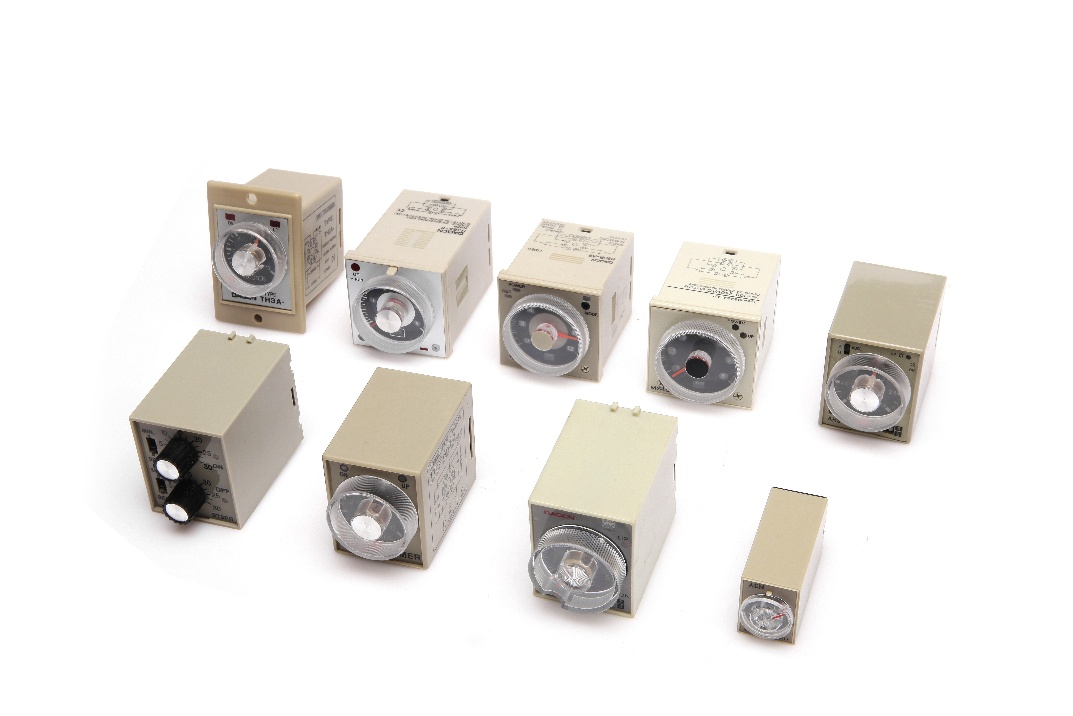
2. On-Delay
On-delay is the most common function. When the coil is energized, the contacts do not switch immediately; they switch only after the set delay. When the coil is de-energized, the contacts return at once. Typical uses: staging motors or heaters so they do not start together, delaying a conveyor until the downstream belt runs, and filtering brief false sensor signals. In sequence terms, start the countdown when power arrives and close the contact when it ends.
3. Off-Delay
Off-delay is the mirror image. The output switches immediately when the coil is energized, and removing the control signal starts the timing: the contacts hold their operated state for the set delay after the coil drops out, then release. Typical uses are a cooling fan that runs a few minutes after a machine stops, a conveyor held clear after the feed stops, and a stairwell light that stays on after the push button is released. True off-delay needs a supply that stays available while the delay runs, so many models have separate supply and control terminals; confirm the wiring in the manual.
4. Interval and Pulse Functions
Interval timing starts when the coil is energized and switches the output on for a set time, then releases it even if the coil stays energized: a timed pulse rather than a delayed steady state. Related single-pulse functions issue one defined pulse at energization, useful for triggering counters or giving a controller a clean start signal. Typical use: a lubrication pump that runs ten seconds each time a machine cycle starts, or a horn that sounds for a few seconds after a fault.
5. Cyclic and Flicker Operation
Cyclic, sometimes called flicker, repeats ON time and OFF time continuously while the coil is energized. The classic example is a flashing warning beacon; another is an extractor or feeder that pulses so material does not pack. The two settings are usually independent: 0.5 s ON and 0.5 s OFF for a beacon, or a longer pair for periodic storeroom ventilation. Because the pattern runs until the coil drops, select the relay with the expected duty cycle and operating count in mind; the datasheet states the life figures.
6. Star-Delta and Other Specialized Timing
Some timing functions belong to a specific circuit. The star-delta transition timer controls the changeover from star to delta in a motor starter, with a short adjustable delay that lets the motor settle before the second contactor closes and a dwell time that prevents a short circuit between the two configurations. Setting it wrongly causes high inrush or contactor damage, so motor-start timing is usually set by the starter designer, not changed casually. Other specialized functions include sequential conveyor starts and off-delay variants with separate terminals. Read every function as a sequence of contact states, not a marketing name.
7. How Functions Are Marked: IEC 61812 Letters
The framework for classifying time relay functions is IEC 61812, which you meet through letter codes on the device or function table: A-type for on-delay, B-type for off-delay, C-type for interval, and D-type for cyclic or flicker operation. Manufacturers extend the letter set with their own designations, and one model can carry several functions selected by switches on the front. Always read the specific model table: the letter gives the family, the table gives the contact behavior, the settings, and what the LEDs mean during timing.
8. Multifunction and Multirange Models: DAQUAN Examples
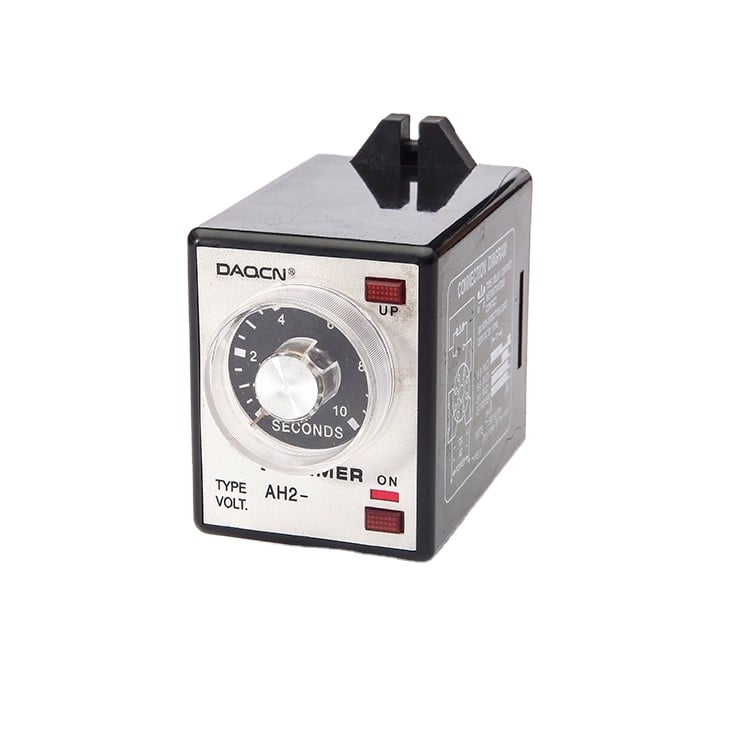
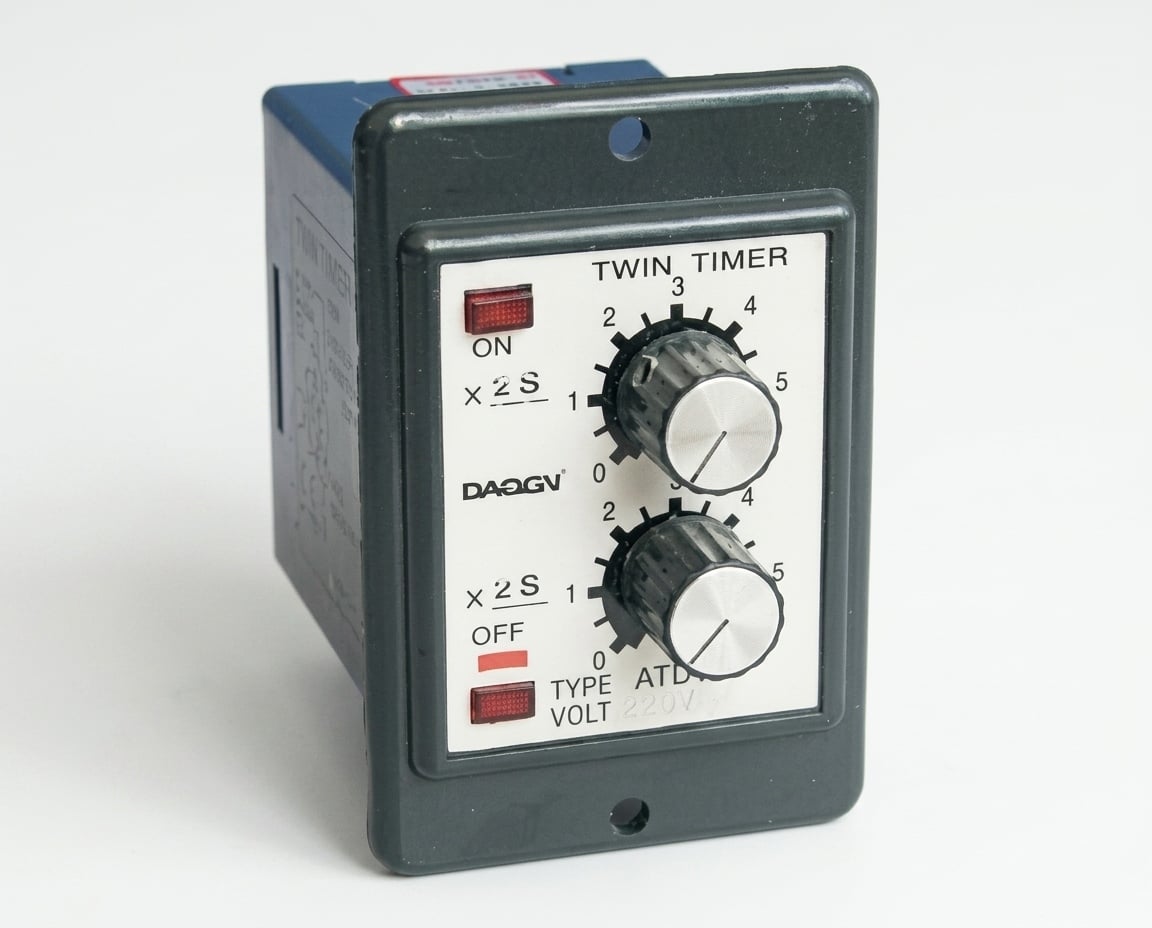
Multifunction time relays exist because a panel rarely needs one function only. DAQUAN makes a range of time relays, from compact multifunction units to digital multi-range models. As examples, the H3BA-8 offers four switchable time ranges covering 0.05 seconds up to 100 hours, and the DH48S series provides digital setting across ranges such as 0.1 seconds to 99 hours in the DH48S-S version, with the DH48S-2Z adding a second output. Other family models, including the ST2P-E, ASY-3D, and DH48G, cover different function sets and mounting styles. Never guess the function list of any model; read the function table on the datasheet.
Three checks make a safe specification. First, list the functions the application needs. Second, confirm the model covers them with a time range that brackets your delays with margin. Third, verify coil voltage, contact rating, and whether off-delay or cyclic functions need a permanent supply. If a datasheet does not state a detail, ask the manufacturer or refer to the product manual.
9. Choose the Function, Not Just the Relay
For a motor starter, the function is likely star-delta transition or on-delay for sequential starting. For a fan that cools a machine after it stops, off-delay. For a beacon or periodic purge, cyclic. For a fixed lubrication pulse, interval. Write the sequence as a timeline first: what happens at energization, after the delay, and at de-energization. Then find the model whose function table matches. A few minutes of sequence thinking prevents the classic field problem of a relay that switches at the wrong moment.
Discover DAQUAN’s CE/TUV-certified relays, timers, energy meters & WiFi smart switches for industrial automation. ISO9001 factory in Wenzhou, 30 km to airport, global OEM/ODM.
No. 172, Xinguang Avenue, Xinguang Industrial Zone, Liushi Town
Copyright © 2026 WENZHOU DAQUAN ELECTRIC CO.,LTD All rights reserved. Privacy Policy
 EN
EN
 Hot News