
Q: How to determine if your application requires a 1-Phase or 3-Phase Voltage Protector based on neutral stability?
Answer:
Voltage fluctuations, power surges, and phase imbalances are major causes of electronic and motor damage in commercial and industrial facilities. To protect critical machinery, HVAC systems, and office electronics, engineers commonly install automatic over and under voltage protectors. However, when specifying these devices, B2B procurement officers and electrical contractors often face a critical question: should they choose individual 1-Phase (Single-Phase) Voltage Protectors or a unified 3-Phase (Three-Phase) Voltage Protector? While the primary power supply configuration of the equipment (220V single-phase vs. 380V three-phase) is the most obvious deciding factor, a deeper, highly critical technical variable must be analyzed: neutral line stability. An unstable or broken neutral line behaves differently depending on system design, and selecting the wrong protection architecture can lead to catastrophic hardware destruction. This technical guide explains how neutral stability affects voltage behavior, how to evaluate neutral health in your facility, and how to determine the optimal voltage protector configuration to safeguard your assets.
Understanding the Critical Role of the Neutral Line
In standard three-phase four-wire electrical systems (such as a TN-S or TT system), the three phase lines (L1, L2, L3) carry the alternating current, while the neutral line (N) provides the return path for current back to the transformer. The neutral line is also connected to the system ground. Its primary function is to act as a reference point, stabilizing the voltage between each phase and neutral at the standard single-phase operating level (typically 220V or 230VAC).
If the loads connected to each of the three phases are perfectly balanced, no current flows through the neutral line. However, in real-world facilities, balanced loads are extremely rare. Lighting, computer systems, and single-phase heaters are distributed across the three phases, creating a phase imbalance. The resulting current imbalance is returned through the neutral line, keeping the system stable.
The Threat of Neutral Instability: Floating and Broken Neutral
Neutral Instability occurs when the neutral line suffers from a loose termination, high-resistance connection, or a complete physical break (known as a Broken Neutral). This condition is one of the most dangerous electrical faults a facility can encounter, leading to a phenomenon called Floating Neutral.
When a neutral line is broken or loose:
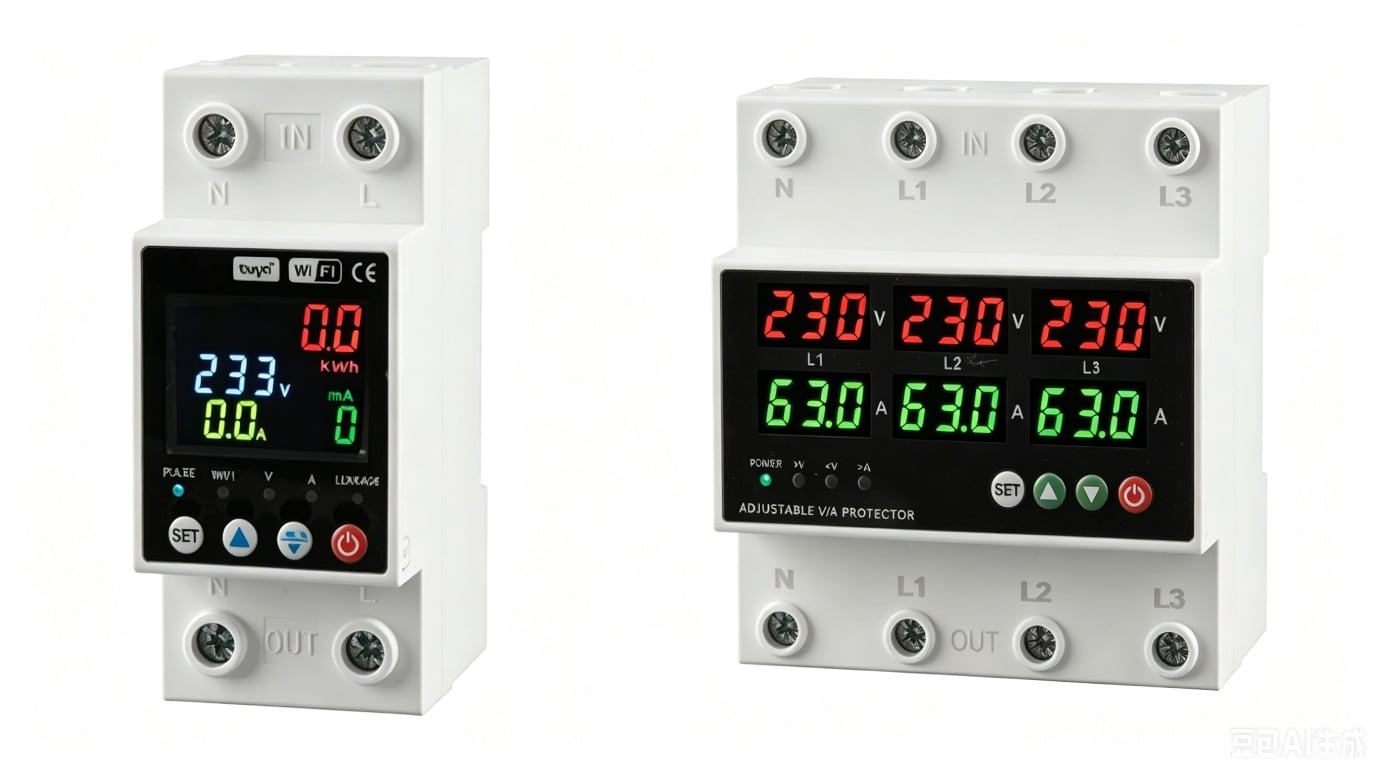
Specify individual 1-Phase Protectors under the following conditions:
When to Specify a 3-Phase Voltage Protector
Three-phase voltage protectors monitor all three phases (L1, L2, L3) and the neutral line (N) simultaneously. They detect overvoltage, undervoltage, phase loss, phase reversal, and phase asymmetry (unbalance).
Specify a 3-Phase Protector under the following conditions:
Before finalizing your procurement specifications, conduct this quick engineering assessment:
DAQCN Self-Resetting Voltage Protectors
DAQCN manufactures an industry-leading selection of self-resetting over and under voltage protectors. Designed with standard DIN rail mounting profiles, bright LED diagnostic screens, and high-performance microcontrollers, our protectors offer instantaneous response times (less than 0.1s). DAQCN 3-Phase voltage protectors include advanced phase unbalance and neutral loss detection, making them the ultimate defense against floating neutral events. For high-current applications, these protectors are wired to control the coils of external magnetic contactors, enabling the protection of systems of any scale.
Conclusion
Determining whether you need a 1-Phase or 3-Phase Voltage Protector depends on a careful analysis of your equipment loads and the stability of your electrical neutral. Single-phase protectors are ideal for isolating individual single-phase branch circuits where the neutral is stable. However, if your facility operates three-phase machinery, suffers from high phase imbalance, or has a history of neutral line issues, a comprehensive 3-Phase voltage protector is critical. Protect your capital equipment and prevent costly downtime by choosing DAQCN's certified voltage protection solutions. Contact the DAQCN sales and engineering department today to find the exact protection devices for your power distribution cabinets.
Discover DAQUAN’s CE/TUV-certified relays, timers, energy meters & WiFi smart switches for industrial automation. ISO9001 factory in Wenzhou, 30 km to airport, global OEM/ODM.
No. 172, Xinguang Avenue, Xinguang Industrial Zone, Liushi Town
Copyright © 2026 WENZHOU DAQUAN ELECTRIC CO.,LTD All rights reserved. Privacy Policy
 EN
EN
 Hot News