

Q: How to Set a Star-Delta Time Relay for Motor Starting: Transition Delay and Wiring Basics?
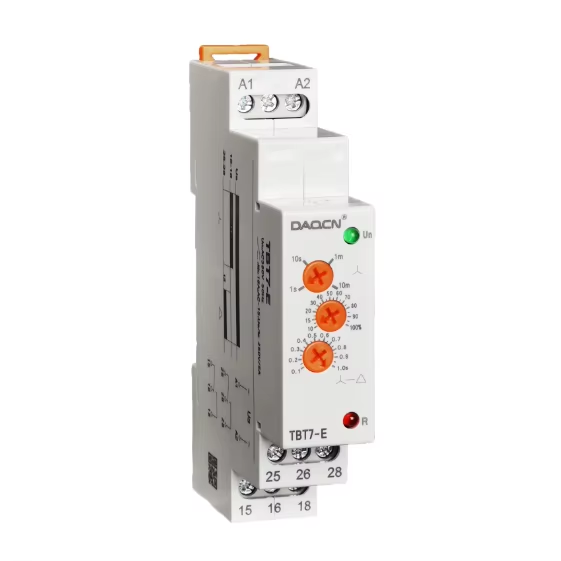
The time relay decides how long the motor accelerates in star before the starter reconnects it in delta. Set the delay from the motor size and the starting load, and let the relay sequence the main, star and delta contactors with a built-in transfer pause that prevents a phase-to-phase short at changeover.
1. Why a Star-Delta Starter Needs a Time Relay
A direct-on-line start can draw six to eight times the motor full-load current. In star connection each winding sees about 58 percent of line voltage, so line current at starting drops to roughly one-third of the direct-on-line value, typically two to two and a half times full-load current. The trade-off is torque, which also falls to about one-third, so the motor must be able to accelerate on reduced torque.
•Star-delta is common for motors from roughly 5.5 to 11 kW upward where the supply authority or the plant network limits starting current.
•It suits loads with low starting torque demand, such as centrifugal pumps, fans and machine tools started unloaded. High-torque or high-inertia loads need a soft starter or other method instead.
•A dedicated star-delta time relay inserts a deliberate changeover dwell, typically tens of milliseconds, between opening star and closing delta. A generic on-delay timer cannot guarantee this pause, so the contactor circuit still needs correct interlocks.
2. Choose the Star Period from the Motor and the Load
The star period must be long enough for the motor to approach rated speed, but short enough that the motor does not run on reduced torque longer than necessary. Most installations use a transition delay in the 3 to 30 second range.
•Start from the motor or starter documentation when it states a recommended transition time.
•As a field rule of thumb, small motors with light starts, up to about 7.5 kW, typically need 4 to 8 seconds; medium motors driving pumps and fans often need 8 to 15 seconds; heavy-inertia starts can need up to 20 to 30 seconds.
•Watch the motor current while starting. In star the current rises, then decays as speed builds. The best changeover point is just after the current has fallen and flattened out, meaning the motor has reached close to its running speed.
•If the motor cannot accelerate within the maximum acceptable delay, the load needs more starting torque than star connection delivers and the starter method should be reconsidered.
•Changing over too early causes a large current spike and a torque jerk at the transfer instant; too late leaves the motor on low torque and running hot.
•Re-check the setting whenever the driven load changes, for example after a pump impeller change or a conveyor modification.
3. How the Time Relay Coordinates KM1, KM2 and KM3
In the usual six-terminal motor, KM1 connects the supply to the winding starts, KM3 links the three winding ends together for the start, and KM2 reconnects each winding end to the line terminal of the adjacent phase for the run.
•Pressing start closes KM1 and KM3 together; the motor accelerates in star while the time relay counts.
•At the end of the star period the timer opens KM3, waits through its internal transfer interval, then closes KM2 while KM1 stays closed for the run.
•KM2 and KM3 must never be closed at the same time. Simultaneous closure connects the windings in a shorted configuration and creates a phase-to-phase short on the supply. Use the mechanical and electrical interlocks shown on the starter diagram in addition to the timer transfer pause.
•A stop command or overload trip drops out KM1 and KM2 and resets the timer so the next start begins again in star.
•Size the contactors and the overload relay per the starter rules in IEC 60947-4-1 and the starter schematic. An overload relay in the line circuit is set to the motor nameplate full-load current; one placed in the delta branch is set for that branch current, commonly 0.58 times full-load current.
4. Avoid the Current Shock at Changeover
Most of the damage in a star-delta start happens at the transfer instant if the timing or the wiring is wrong.
•Always open the star contactor before closing delta, and never close KM2 while KM3 is still closed, even for a few milliseconds. The short open interval lets the starting current decay fully so KM2 closes onto a running motor instead of into a short.
•Verify that the timer output contacts are rated for the contactor coils they drive and that the timer supply matches the panel control voltage.
•Fit the upstream short-circuit protection for the delta running current of the motor with a reasonable margin, keeping the overload protection in circuit for both starting modes.
5. Verify the Relay Setting Before Handing Over
A five-minute bench check prevents a failed first start on site.
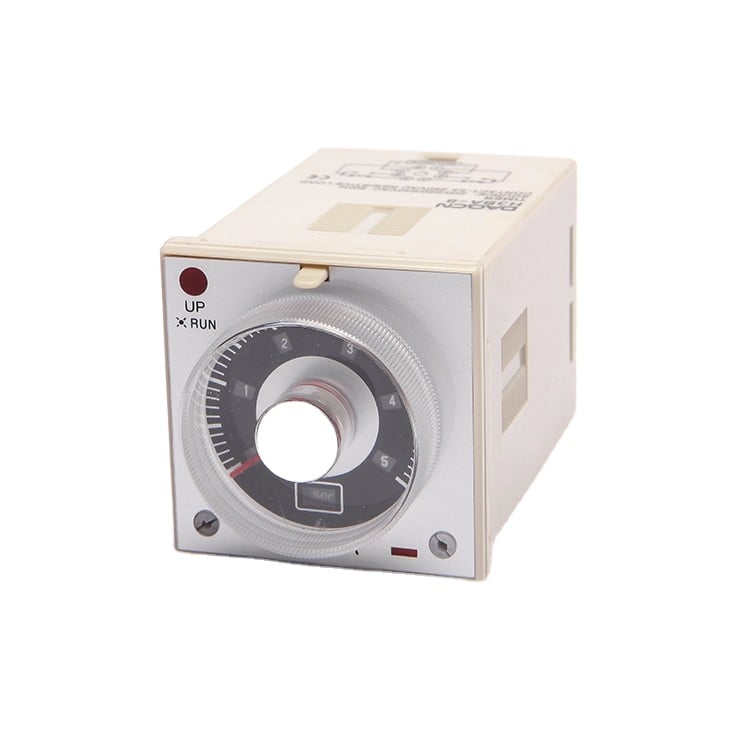
•DAQUAN offers dedicated star-delta relays and multi-function time relays for motor control; choose a unit whose time range covers your intended setting with room to adjust.
•Confirm the function diagram printed on the relay: star output, delta output and the changeover behavior must match the starter sequence described above.
•Power the relay from the panel control supply, measure the star interval with a stopwatch, and confirm the gap between star opening and delta closing appears on every cycle.
•Record the final setting on the panel label or wiring diagram so maintenance staff can restore it after a replacement.
For unusual loads or supply conditions, verify the setting by measuring the actual starting current during commissioning rather than relying on the rule of thumb alone.
Discover DAQUAN’s CE/TUV-certified relays, timers, energy meters & WiFi smart switches for industrial automation. ISO9001 factory in Wenzhou, 30 km to airport, global OEM/ODM.
No. 172, Xinguang Avenue, Xinguang Industrial Zone, Liushi Town
Copyright © 2026 WENZHOU DAQUAN ELECTRIC CO.,LTD All rights reserved. Privacy Policy
 EN
EN
 Hot News